
Africa is entering one of the largest infrastructure expansion cycles in modern history. Yet across the continent, too many billion-dollar projects continue to end the same way – delayed, disputed, over budget or abandoned entirely.
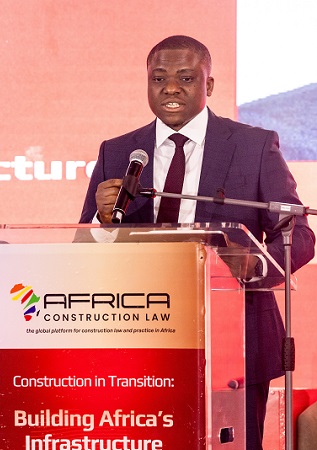
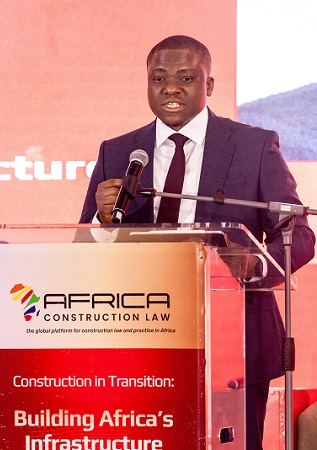
For Ngo-Martins Okonmah, founder and executive director of Africa Construction Law (ACL), this is not merely an engineering problem. It is a legal, institutional and governance crisis hiding in plain sight.
When Africa Construction Law (ACL) held its sixth annual conference in Johannesburg this month, it marked more than a geographic milestone.
For the first time, the organisation brought together a gathering of legal practitioners, construction and building experts, financiers, engineers and project developers to South Africa – a deliberate choice given the country’s position as one of the most sophisticated and established construction markets on the continent.
The event was hugely successful, drawing a large international audience.
ACL is a pan-African initiative established by construction law practitioners from across Africa and the diaspora. It was founded in 2020 with a clear mission: To serve as the global platform for construction law and practice in Africa, providing a forum for lawyers, dispute resolution specialists, contractors, consultants, employers and government authorities to network and discuss the development of construction law and the resolution of disputes across the continent.
In the space of six years, ACL has developed into a continental network spanning more than 13 African countries, with representation across all six African sub-regions as well as London and the UAE. Through its conferences, training academy, publications, webinars and awards, the organisation is steadily positioning itself at the centre of Africa’s evolving infrastructure and construction law ecosystem.
At the centre of it all is Ngo-Martins – ACL’s founder and executive director and head of the construction practice at the award-winning Nigerian law firm Aluko & Oyebode –who is increasingly one of the continent’s most visible voices on infrastructure governance, construction disputes and project delivery reform.
The logic underpinning ACL’s mission is straightforward. Economic integration at scale requires physical connectivity. Roads, ports, energy grids and digital infrastructure are not merely desirable development ambitions – they are the foundation for a functioning African market. Yet the delivery of those projects has consistently fallen short.
“Time is money in construction and economic terms,” Ngo-Martins. “When you budget for a project at fifty billion US dollars and end up spending seventy-five billion, that is significant.”
Cost overruns, delayed timelines, quality deficiencies and project disputes are not occasional irritants within Africa’s infrastructure landscape. They are structural challenges with direct implications for economic development, investment confidence and regional integration. Ngo-Martins argues that “Infrastructure does not fail only because of engineering problems. Projects also fail because the legal and commercial systems around them fail.”
For Ngo-Martins construction is far more than steel, cement and bridges: “There is financing, there are contracts, there is risk allocation and there are dispute systems. Those frameworks ultimately determine whether projects succeed or collapse.”
The standard contract models governing African infrastructure projects, he argues, were developed for stable and predictable economies. They were not designed for environments characterised by currency volatility, inflation shocks, fragile supply chains, political uncertainty or complex community dynamics.
“Africa cannot continue building trillion-dollar infrastructure while remaining peripheral in the systems governing project risk and dispute resolution. “For example, many contracts were not designed with hyperinflation in mind. They do not adequately account for currency shocks in jurisdictions where projects are benchmarked in US dollars but executed in local currency. They can struggle to accommodate the realities of supply chain disruption in import-dependent economies, or the particular hazards of site access in contexts where community relations and ‘construction mafias’ are genuine operational risks,” he says.
For too long, African infrastructure has often been financed externally, structured externally and disputed externally. ACL is part of a broader effort to ensure Africa increasingly develops the institutional confidence and professional capacity to shape these projects on its own terms.
Giving Africa a voice
One of ACL’s broader objectives is to increase the visibility and credibility of African specialists operating within the infrastructure and dispute resolution sectors.
Construction remains one of the world’s largest industries and disputes over payment, delays, defects, or scope changes can derail entire projects and strain national economies. And yet awareness of construction law as a specialist discipline remains limited across much of Africa.
Ngo-Martins traces his awareness of these gaps to his time studying for a specialised MSc in Construction Law and Dispute Resolution at King’s College in London. The programme was, he recalls warmly, one of the finest experiences of his professional life. But it underscored an absence.
“The conversations were largely centred around foreign institutions and foreign projects,” he recalls. “There was limited engagement with what was actually happening across Africa. Even now, major infrastructure projects on the continent are structured, and their disputes resolved, outside Africa entirely. That experience helped shape ACL’s purpose: Building the capacity, visibility and credibility of African practitioners so that expertise no longer has to be imported by default.
“We also want to spotlight the field itself, as so few people know identify themselves as construction lawyers in Africa, yet infrastructure will define much of the continent’s economic future.”
ACL is also seeking greater engagement with African universities to encourage the development of specialist construction law programmes – an area that remains significantly underdeveloped across the continent.
The ACL Training Academy is the education arm of ACL. The Training Academy already offers professional courses and executive masterclasses for lawyers, engineers, quantity surveyors, project managers, contractors and dispute resolution professionals.
Celebrating homegrown excellence
One of ACL’s most deliberate initiatives is its awards programme, which recognises outstanding African practitioners, firms and infrastructure projects across the continent. For Ngo-Martins, the awards are about more than recognition.
“As Africans, we often do not celebrate our own enough,” he says. “When people ask why so much work is exported outside the continent, the first assumption is often that there is insufficient local capacity. I disagree with that.”
The awards, he argues, challenge that perception by showcasing world-class African expertise operating successfully within complex infrastructure projects and disputes. “We need to recognise excellence on the continent,” he explains, “and we need to celebrate it because it is important for those coming after us.”
Looking ahead, ACL intends to deepen its engagement with governments, institutions and policymakers as part of a wider push toward regulatory reform and improved project governance across Africa.
“ACL is shaping the conversation around infrastructure and policy reforms on the continent,” Ngo-Martins emphasises. “The success or failure of infrastructure delivery will shape Africa’s industrialisation, energy transition, regional integration and long-term economic competitiveness.”
Africa’s infrastructure future, he argues, will not be determined by ambition alone: “It will depend on whether the continent can build stronger systems around procurement, contracts, project governance and dispute resolution. This is the conversation ACL is trying to lead.”
Because ultimately, Africa’s infrastructure challenge is not simply about building projects. It is about building the systems capable of delivering them.