

Marine conservationists face countless technical challenges in their mission to protect ocean ecosystems.
From securing coral fragments in turbulent waters to maintaining research equipment in corrosive saltwater
environments, the practical demands of underwater conservation work require reliable, environmentally
safe solutions.
To succeed in this mission, traditional methods often cannot meet these enormous technical challenges.
Conservationists need methods and materials that can bond effectively in underwater environments. Ultimately
these materials need to resist corrosive marine conditions and withstand constant saltwater exposure and
temperature variations, while remaining environmentally safe for sensitive ecosystems, and providing reliable long
term performance in harsh conditions.
These demanding conditions have led conservation teams to seek innovative solutions from unique sources. One
such solution is Pratley
Standard Setting Putty , a high-performance adhesive originally designed for industrial use.
The product has proved to be a game-changer in conservation.
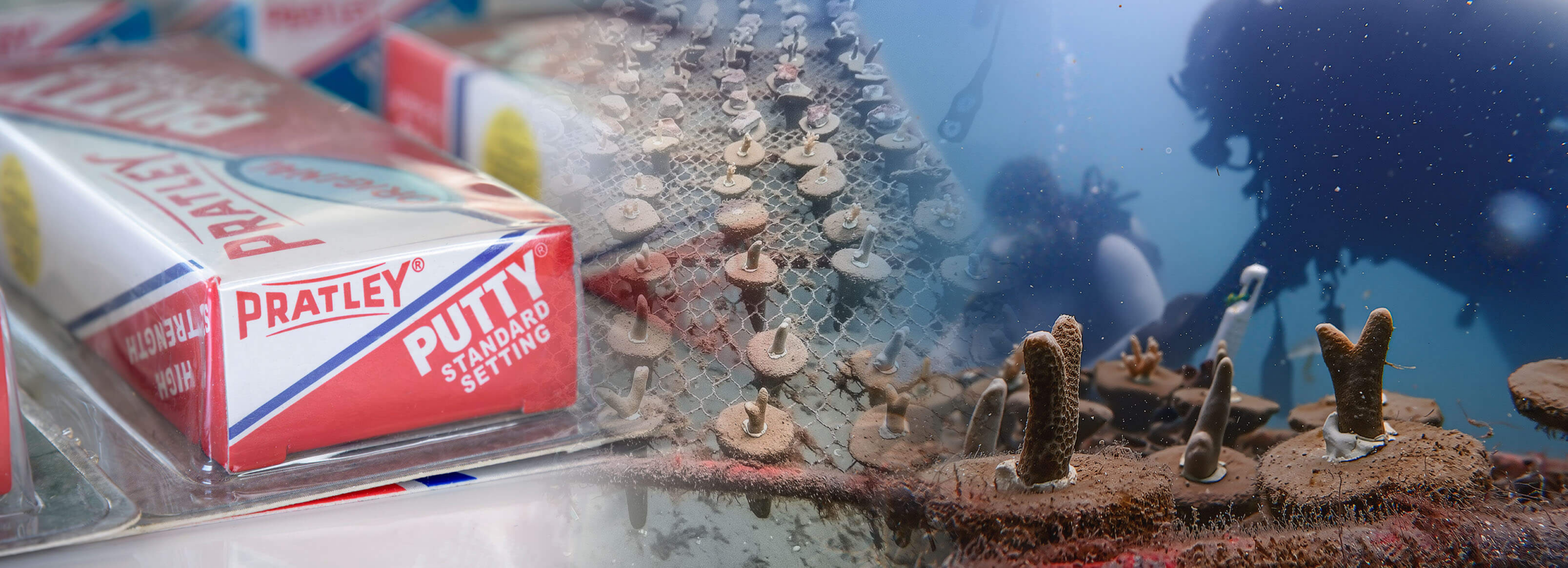
“Conservationists discovered that Pratley Putty could be used underwater to attach coral fragments to
reef structures without harming marine life,” highlights Mark Bell, National Sales and Marketing Manager
at
Pratley. “Once cured, it is chemically inert and does not release harmful substances, making it ideal for
sensitive ecosystems.”
A skindiver mixes Pratley putty and places it into a plastic bag to take down to a new coral bed, a straightforward
approach that makes underwater use feasible. This practical method has opened new possibilities for reef
restoration work, providing conservationists with reliable tools for securing coral fragments where traditional
adhesives often fail.
Pratley’s contribution to reef projects aligns with a growing philosophy in conservation: repair over replacement.
Instead of rebuilding from scratch, restoring ecosystems with minimal disturbance is often more sustainable.
Marine conservation represents just one application of industrial adhesives in wildlife protection initiatives. These
materials have been used in projects including the repair of damaged sea turtle shells and the attachment of radio
transmitters to pangolins and rhinos for research and monitoring purposes.
Such applications demonstrate the versatility of industrial products in addressing various conservation
challenges, from emergency wildlife care to research applications that support long-term species monitoring and
protection efforts.
“The success of these applications reflects both the technical excellence of suitable products and the innovative
thinking of conservation professionals who recognise opportunities to adapt industrial solutions for environmental
purposes,” notes Bell.
“As conservation challenges continue to evolve, such partnerships between industry and environmental
organisations will likely become increasingly important for achieving meaningful protection outcomes,”
he concludes.