
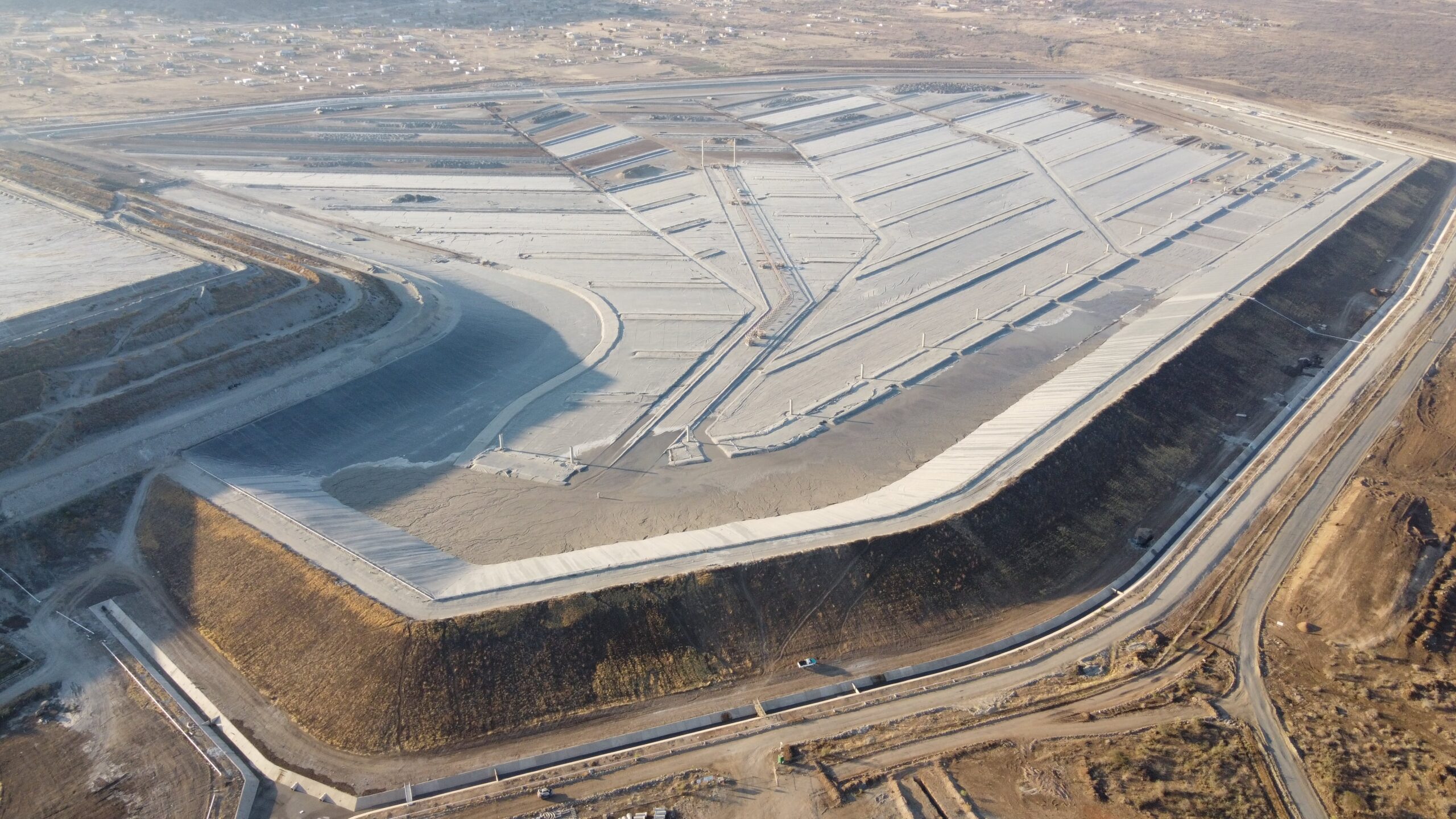
In many mine-wide water balances, the tailings storage facility (TSF) still appears as a single line item – a convenient ‘black box’ where water goes in, something comes out, and the rest is blurred, assumed or simply left unknown. Yet the TSF is one of the largest and most dynamic water stores on site, with stored water volumes directly affecting stability, water recovery and regulatory compliance. By recasting the TSF as a ‘blue box’ instead – a clearly defined, quantified system with known inflows, outflows and storage – operators gain the transparent, decision-ready information they need to manage these facilities proactively over their full life cycle.
According to Annelie Scholtz, civil engineer at SRK Consulting, a critical issue in current practices is that site-wide water balances often do not explicitly state the current storage volume of water contained within the TSF. A paper was presented at the Southern African Institute of Mining and Metallurgy (SAIMM) 2026 Tailings Conference, where Scholtz argued that this leaves the facility as essentially a ‘black box’ – allowing little insight into operational behaviour and safety risks.
The paper, entitled ‘TSF-Specific Water Balance as a Standard Practice’ was co-authored by Scholtz and SRK Consulting principal engineer Kurt Uderstadt, environmental scientist Louis de Villiers and corporate consultant Dr Graham Howell.
Measure to manage
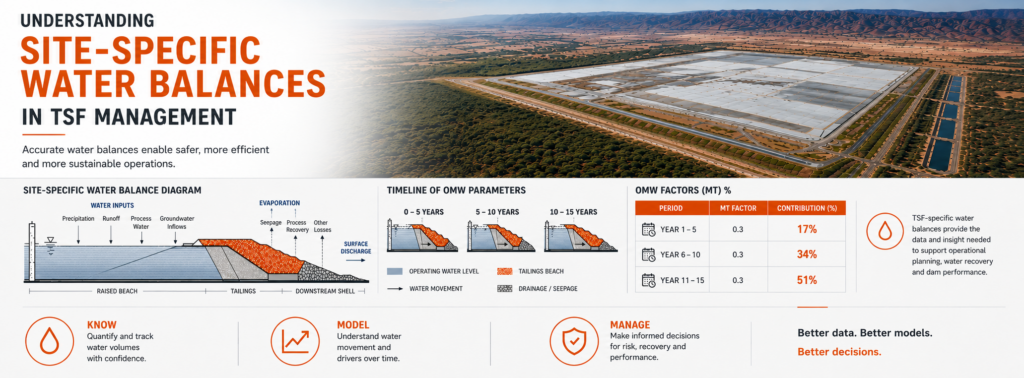
“If the volume of water in the TSF cannot be quantified, it cannot be effectively managed,” argued Scholtz. She explained that a typical water balance follows a fundamental equation where inflows minus outflows equals ΔS – the change in storage volume.
“Inflows include slurry water, precipitation on the TSF surface, surface runoff entering the TSF and groundwater inflows,” she said. “Outflows include evaporation from the TSF surface, seepage through the TSF base and walls and recovered water via decant systems and underdrains – as well as entrapped water within the tailings.”
She highlighted that a staged approach allows operators to move from simple checks to comprehensive modelling – so they can visualise how water storage changes over time. This transforms the facility into a managed ‘blue box’ system to reduce risks while supporting sustainable and responsible water use.
“This progression paves the way for proactive management, so that boundary conditions such as phreatic surface levels and freeboard requirements are continuously monitored,” she said. “Importantly, preventative actions can then be timeously triggered, such as halting deposition during extreme rainfall events.”
Three stages
Scholtz proposed a structured three-stage process to develop a robust water balance for a TSF, giving mines the ability to assess its storage capacity effectively. This begins with a basic ‘matchbox’ check, where current information at hand is used to compare inflows and outflows – giving an estimate of changes in storage. This might take a matter of days or weeks.
“The second stage is more informed by data from site monitoring, to refine the stage one estimates, and could take from a few weeks to three months,” she said. “Data should include slurry densities, rainfall records, evaporation records, pond levels, seepage flows, piezometer measurements and phreatic levels.”
The third stage is a detailed analysis using advanced tools such as three-dimensional modelling, survey data, and geotechnical investigations to capture the spatial and temporal behaviour of water within the facility.
“It involves a detailed process to acquire spatially distributed hydraulic and geotechnical properties, bathymetry, survey grids, 3D models and ensembles – all related to the stability of the facility,” she said. “The time to complete this phase may be anything from three months to a year.”
Valuable tool
Progressing systematically through these stages allows a mine to turn the water balance from a simple check to a comprehensive management tool, ensuring that both short-term operations and medium and long-term risks can be fully addressed.
“Conducting a site-specific water balance for a TSF is essential for moving beyond assumptions and unknowns,” she emphasised. “The exercise allows operators to quantify, track and manage the movement and storage of water – with several important outcomes.”
Among the most important of these are clarity on water storage and early warning of risks, along with useful insights into whether the TSF is being constructed and managed as per design. Storage volumes in the facility are central to both stability, water recovery and water supply planning, while risks can be flagged by discrepancies between inflows and outflows – from seepage, rising phreatic surfaces or unmeasured discharges.
An accurate water balance creates a structured basis for operational decisions such as assessing energy balance, reducing pond size, adjusting deposition, changing of slope angle, enhancing drainage or preparing for storm events.
“It (a blue box approach) can even help mines improve their water efficiency by quantifying return water and losses – supporting process water recovery and reducing reliance on external water sources,” said Scholtz.
Given the inherent risks of water-driven TSF behaviour and increasing pressure on mines to use water efficiently, the era of treating TSFs as opaque ‘black boxes’ is over. Adopting TSF-specific water balances as standard practice turns that blurred, assumption‑based view into a ‘blue box’ – a well‑understood, continuously updated picture of how much water is stored, where it is, and how it moves. This shift from unknowns to quantified insight underpins safer operation, sharper responses to changing conditions, improved water recovery, and more transparent engagement with regulators and stakeholders, firmly positioning the TSF as a managed asset rather than an unmanaged risk.