
Local and international expertise support science-based limits and infrastructure responses to emerging contaminants of concern in South Africa
20 May 2026: Global infrastructure leader AECOM is urging the introduction of enforceable regulatory limits for per- and polyfluoroalkyl substances (PFAS) in South Africa, as a growing body of evidence highlights widespread PFAS detections across water systems and increasing divergence between existing local regulatory frameworks and internationally applied standards.
The findings, detailed in a new article for publication in a leading scientific journal, authored by AECOM specialists across Africa and the United States, indicate that PFAS, a large family of highly persistent and mobile fluorinated organic compounds, are being detected in surface water, groundwater, wastewater, drinking water, and even rainwater across multiple provinces.
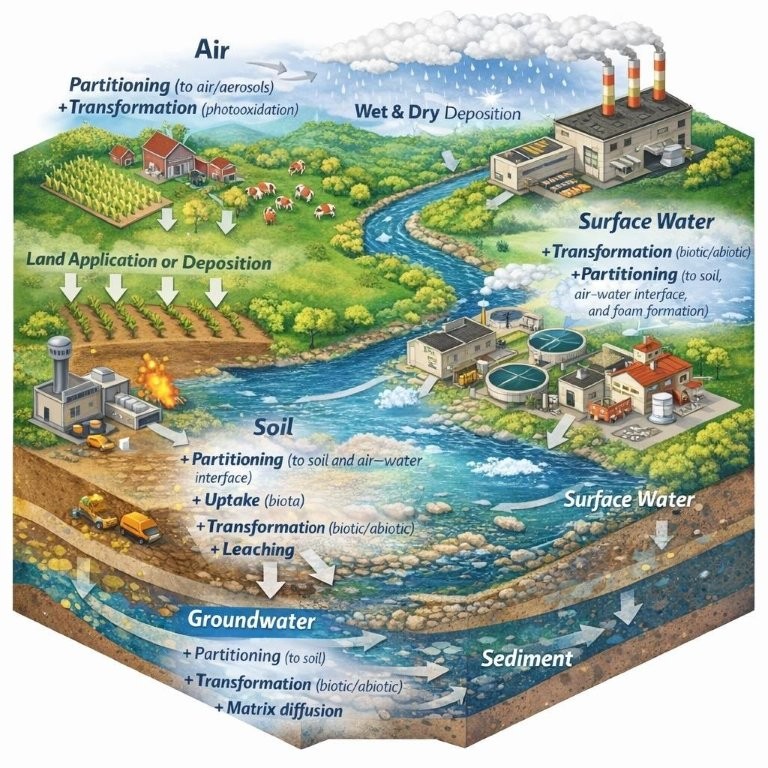
Dr. Anthony Mader, Senior Environmental Scientist at AECOM Africa and lead author, says that multiple lines of evidence point to a need for regulatory intervention. “South Africa is no longer dealing with isolated PFAS detections. A national assessment, supported by multiple site‑specific scientific studies, shows persistent PFAS contamination across water systems, driven by multi‑source inputs and governed by complex physicochemical fate and transport processes,” notes Dr. Mader.
“Although direct comparisons between local and international datasets require caution due to differences in analytical scope, at some hotspot locations across South Africa, concentrations exceed multiple international benchmarks, yet there is currently no enforceable regulatory framework to drive mitigation. Establishing clear, science-based limits is the most effective way to protect both public health and long-term water security,” adds Dr. Mader.
PFAS are widely used in industrial processes
Due to their surfactant properties and resistance to physical, biological, and chemical degradation, PFAS are widely used in industrial processes, firefighting foams, and consumer products. These same fluorinated carbon chains confer resistance to degradation and enable long-range transport and bioaccumulation, and therefore, incorporation into food chains and ecosystems.
The AECOM article highlights research that conventional wastewater treatment processes are largely ineffective at removing PFAS, particularly short-chain variants, which are increasingly dominant in South African water systems. Dr. Khathutshelo Netshiongolwe, lead of AECOM’s South Africa Environmental Data Management team and co-author, emphasised the implications for water management.
“Utilities are facing a class of contaminants that current infrastructure was never designed to remove. Without regulatory drivers, there is limited incentive to invest in advanced treatment technologies or implement upstream source control. This creates a cycle of continuous environmental contaminant loading.”
Global strengthening of PFAS regulatory frameworks
Globally, PFAS regulation tightened markedly between 2024 and 2026. The United States adopted enforceable standards in the nanogram per litre range (one-part PFAS in one billion parts water), Australia and Canada lowered national guideline values, the European Union brought binding PFAS limits into force, and the UK strengthened PFAS policy, monitoring, and regulatory frameworks.
The AECOM article highlights that many South African water sources would exceed these thresholds if assessed under international standards. “PFAS regulation is rapidly evolving worldwide, with a clear shift toward group-based and mixture-based regulatory approaches,” comments Dr. Rosa Gwinn, Global PFAS Lead at AECOM and an AECOM Fellow. “South Africa has an opportunity to leapfrog legacy regulatory models by adopting a science‑led framework that reflects both global best practice and local conditions.”
A pragmatic path forward
The authors propose a multi-tier regulatory framework tailored to South Africa’s PFAS profile, combining individual compound limits with broader group-based controls. Key recommendations include a coordinated, science-based regulatory process; mandatory national monitoring based on accepted laboratory methods; targeted infrastructure upgrades in high-risk catchments; and the development of a national PFAS inventory.
Dr. Brandon Barnardo, Junior Environmental Scientist at AECOM, notes that engineering demand is already shifting in response to global regulatory pressure. “Globally, we are seeing a clear pivot toward PFAS-focused design and optimisation. Technologies such as granular activated carbon, ion exchange, and reverse osmosis are becoming essential components of modern water treatment systems.”
AECOM’s multidisciplinary PFAS practice combines advanced analytics, PFAS forensics, fate and transport and source-pathway-receptor modelling, and treatment technologies to support clients in managing both legacy contamination and emerging risks.
Walter Fyvie, Associate Director, AECOM Africa Environment, and Elisabeth Nortje, Director, AECOM Africa Environment, conclude that addressing PFAS is not just a compliance issue but a long-term resilience challenge. By acting now, South Africa can align with global standards, protect critical water resources, and build infrastructure systems that are fit for the future, ultimately creating Sustainable Legacies.