
Additive Depletion: When Oil Runs on Empty
By Steven Lumley, technical manager, WearCheck
Specialist condition monitoring company, WearCheck, continues the discussion around oil condition – the latest topic is additive depletion.
Tell me if this sounds familiar – you glance at your phone and see 12% battery remaining. Not ideal, but surely enough to reply to one more message, check the weather and use the map for “just five minutes”.
Then the screen dims, the battery icon turns red and panic sets in. Suddenly that very clever little device with all its apps, contacts and computing power becomes a very expensive rectangle of glass.
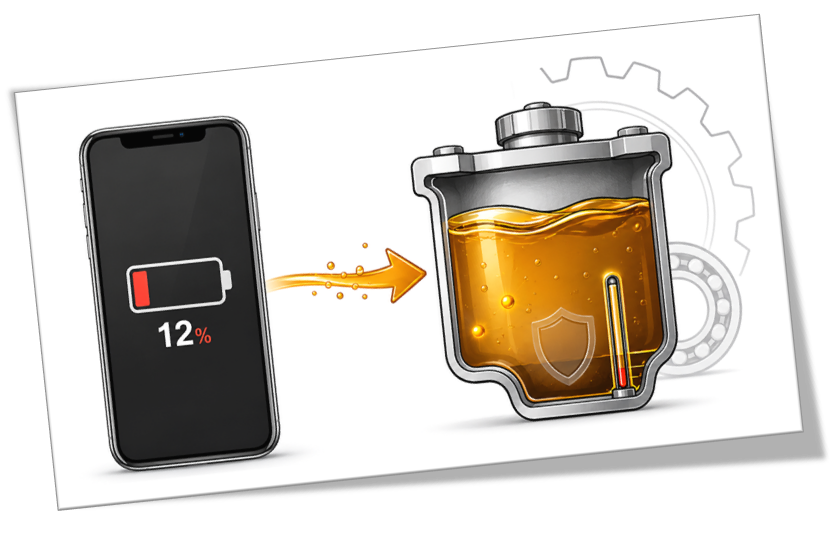
The phone is still there; the hardware has not disappeared, but the reserve that allows it to function has run out.
Lubricants are not quite as dramatic – they don’t flash a red battery icon, but additive depletion follows a surprisingly similar logic.
Modern lubricants are carefully formulated blends of base oil and additives. The base oil provides the lubricating film, and the additives provide much of the protection needed to survive real-world operating conditions. They help resist oxidation, reduce wear, control foam, neutralise acids, keep contaminants suspended and protect against corrosion. But there is a catch.
Most additives are sacrificial in nature. They protect the oil and the machine by being used up, altered, adsorbed onto surfaces or removed from circulation. That is not a formulation failure, it is exactly how they are designed to work.
This is additive depletion – the point where the oil may still be present, but its protection is running on empty.
What Are Lubricant Additives?
Lubricant additives are organic or inorganic compounds dissolved or suspended in oil. They help the finished lubricant do more than the base oil could achieve on its own.
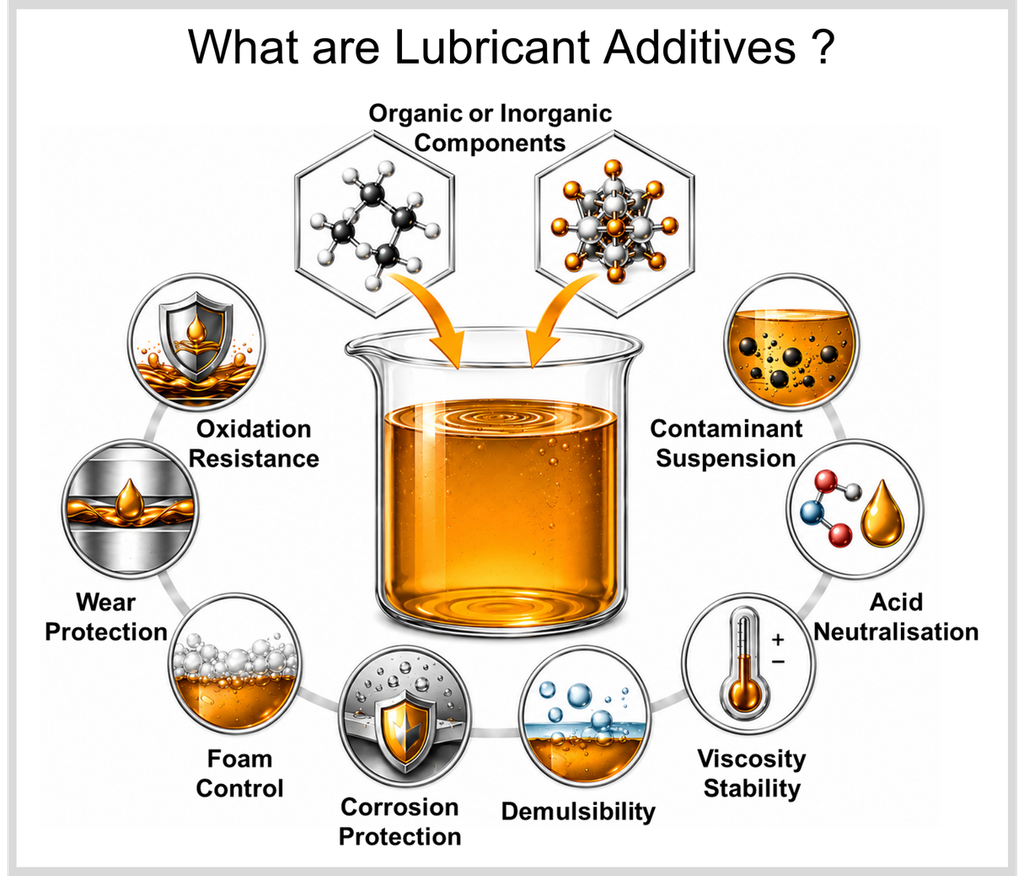
Base oils provide the foundation of lubrication, particularly film formation, heat transfer and fluid movement, but additives build on that foundation by enhancing useful properties, suppressing unwanted ones or adding new performance characteristics.
The exact additive package depends on the application. A lightly additised turbine oil is very different from a heavily additised diesel engine oil. Your oil, in other words, is not just “oil”. It is a carefully balanced chemical recipe, and exhausting one ingredient can affect the whole dish.
How Additives Get Depleted
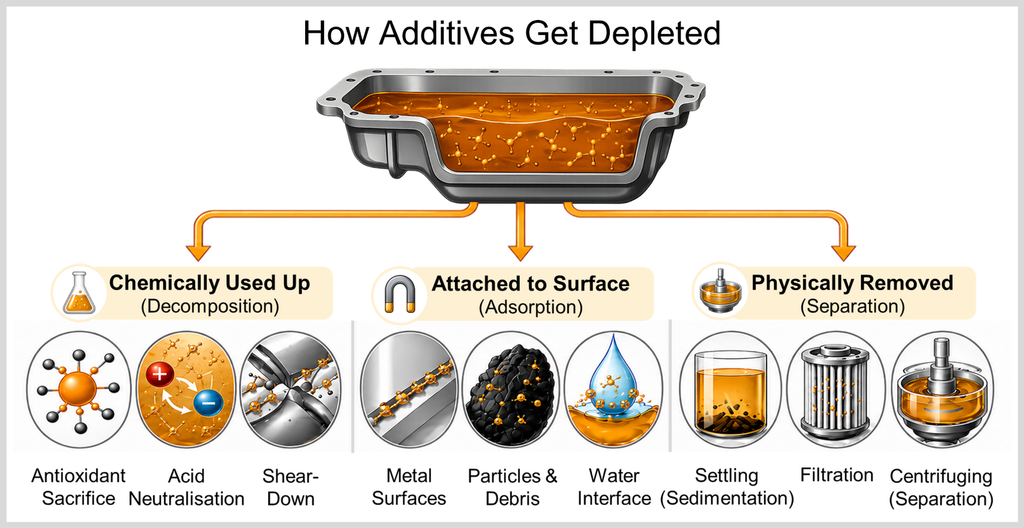
Additive depletion can appear complicated, because many individual mechanisms are involved, including neutralisation, shear-down, hydrolysis, water washing, particle scrubbing, surface adsorption, filtration, evaporation and centrifuging.
A simpler way to make sense of them is to group them into three broad pathways: additives can be chemically used up, attach to surfaces, or be physically removed from the oil. These pathways are often described as decomposition, adsorption and separation, with the individual mechanisms simply being examples of each category.
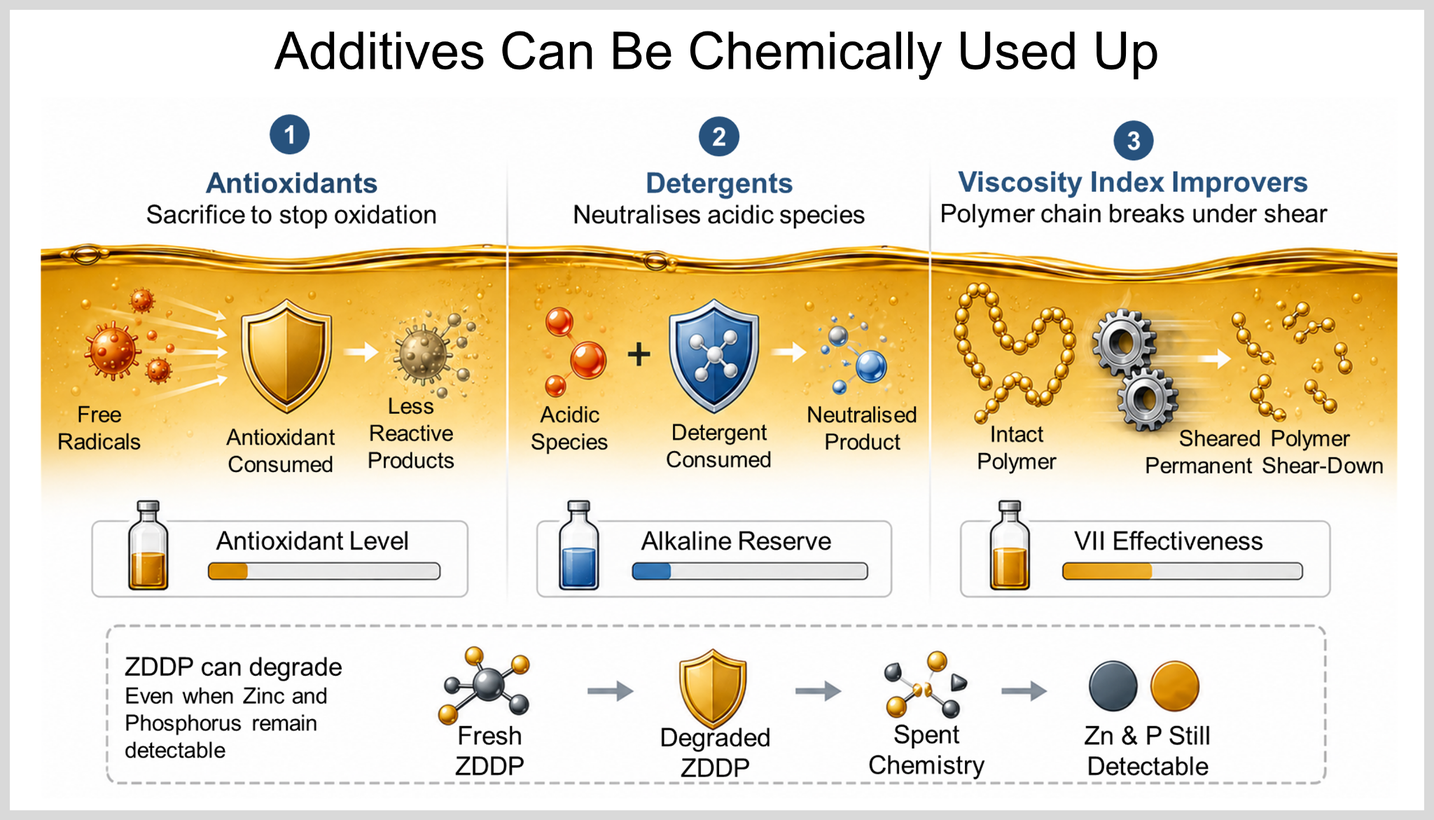
Additives Can Be Chemically Used Up
The first pathway is chemical depletion, or decomposition. This occurs when an additive molecule is consumed, transformed or broken down so that it can no longer perform its original function.
Antioxidants are a good example. They interrupt oxidation by reacting with free radicals before those radicals attack the base oil; but in doing so, the antioxidant sacrifices itself. Once that reserve is depleted, oxidation can accelerate rapidly.
Detergents in engine oils work in a similar way. Overbased calcium or magnesium detergents neutralise acidic combustion by-products, gradually consuming the oil’s alkaline reserve. Once that reserve is exhausted, acids can accumulate rapidly, increasing the risk of corrosion and deposit formation.
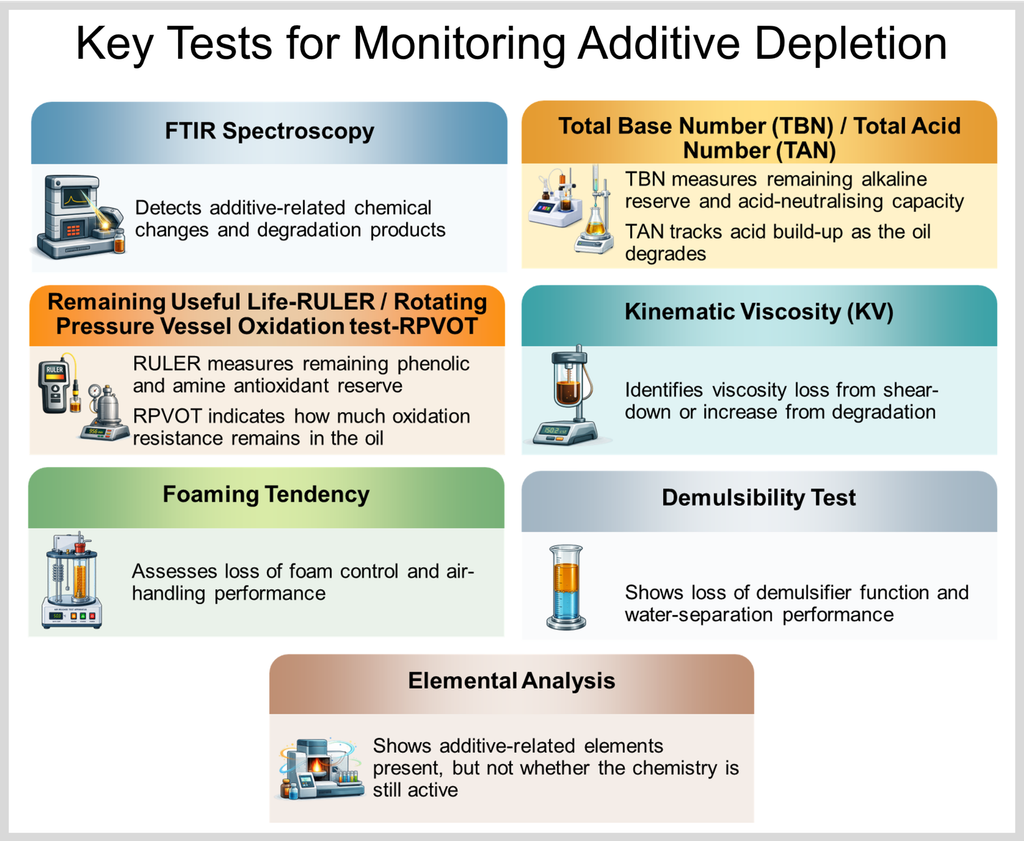
Other additives can also be changed by heat, water or severe operating stress. Zinc dialkyldithiophosphate, or ZDDP, is a common anti-wear and antioxidant additive that can degrade through several pathways. Importantly Zinc and Phosphorus can still appear in an oil analysis report even though the original ZDDP molecule no longer behaves like fresh additive. This is why additive depletion cannot always be judged by elemental analysis alone.
Shear-down is another example. Viscosity index improvers are large polymer molecules that can break into shorter pieces under severe mechanical shear, causing permanent viscosity loss. In each case, the additive is not simply missing, it has been spent, changed or broken.
Additives Can Attach to Surfaces
The second pathway is adsorption. Many additives are polar, meaning they are naturally attracted to surfaces – a property that allows them to form protective films where they are needed.
Anti-wear and extreme-pressure additives react with, or adsorb onto, metal surfaces, especially under boundary lubrication conditions where the oil film is thin. They form sacrificial films that reduce wear and scuffing, but these films are continually worn away and replenished from the additive reserve. Like sunscreen, they protect by taking the punishment themselves, but once used up or washed away, the protection is gone.
Adsorption becomes a problem when additives attach where they are not useful. Fine wear debris, sludge, water droplets and other suspended material can attract polar additives, stripping active chemistry from the oil before it reaches the surfaces that actually need protection. This is known as particle scrubbing or additive stripping.
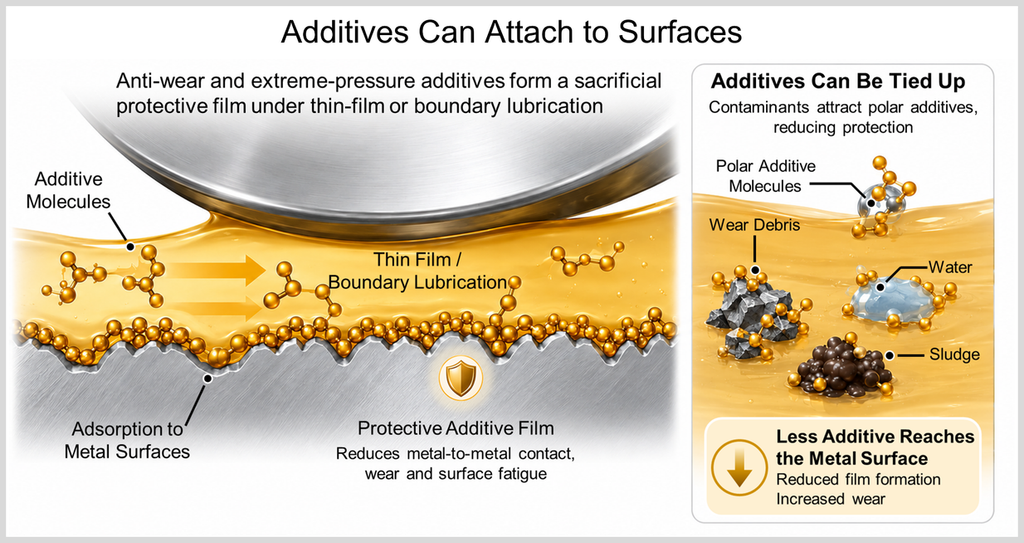
Water can have a similar effect, carrying some polar additives away from where they are needed. We will return to water and other unwanted guests in the next instalment, but for now, the key point is simple – contaminants can tie up additive chemistry before it can do its job.
Additives Can Be Physically Removed
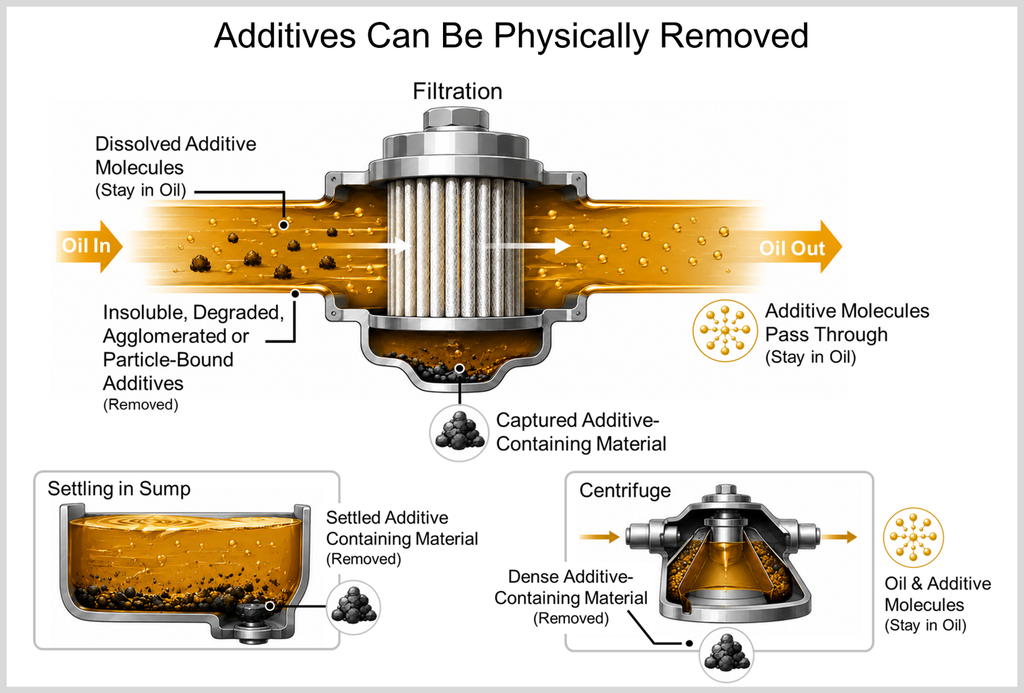
The third pathway is separation, or physical removal. In this case, additives or additive-containing materials leave the oil or are removed from circulation.
This can happen when additives become insoluble and settle to the bottom of a sump, or when spent additives attach to sludge, wear debris or other particles that are removed by filtration. In some systems, centrifuges may also separate dense, additive-containing material along with contaminants.
Filtration often raises the question of whether filters can remove additives from oil. In a properly formulated lubricant, normal filtration does not simply strip out dissolved additives, because most additive molecules are far smaller than filter pores. However, additives that are insoluble, degraded, agglomerated, attached to particles, or present as larger suspended material, may be removed. Silicone antifoam additives are a common exception, because they may exist as dispersed droplets rather than fully dissolved molecules.
So, the filter is not usually the villain. In many cases, it is removing material that is already spent or no longer properly dissolved.
Why Additive Depletion Matters
Additive depletion matters because the base oil may still look serviceable, while its protection system is quietly running down.
Once antioxidants are depleted, oxidation accelerates. Once detergents are consumed, acids are no longer neutralised. Once anti-wear additives are exhausted, metal surfaces lose boundary protection. Once dispersants, foam inhibitors or demulsifiers are depleted, sludge, foaming and poor water separation can follow.
In service, this can mean increased wear, corrosion, varnish, filter plugging, viscosity changes and – ultimately – shortened oil life. The lubricant may still be circulating, but it is no longer fully doing the job it was selected to do.
Detecting Additive Depletion Through Oil Analysis
Oil analysis plays a critical role in monitoring additive health, but interpretation requires care. Additive depletion is rarely understood from a single result in isolation, and one test seldom tells the whole story. The key is trending – comparing the used oil to the correct new oil baseline, then watching how the additive profile, degradation markers and machine-wear indicators change together over time. In oil analysis, as in life, context is everything.
The key tests used to assess additive depletion are summarised below:
Final Thought
Additives are the quiet workers inside a lubricant, constantly defending the oil and machine against heat, acids, wear, foam, corrosion and deposits. But every defence has a limit.
When additive reserves are healthy, the lubricant can absorb stress and protect critical components. When those reserves are depleted, the oil may still be present, but its protective chemistry has been spent.
Additive depletion is therefore an early warning that the lubricant’s built-in defence system is being consumed. And many of the things that accelerate that consumption arrive as unwanted guests: water, dirt, soot, fuel, coolant and other contaminants.
In the final instalment of this series, we look at Contamination – Oil’s Dirty Little Secret.
Please visit www.wearcheck.co.za or contact WearCheck on marketing@wearcheck.co.za or +27 (31) 700-5460.